Books
Three books on unlocking the abilities of others
Written for leaders who want something they can use on Monday morning — principles first, then a method for putting them to work.

Becoming a Servant Leader, 2nd Edition
The Art of Unlocking the Abilities of Others to Get Things Done
2nd Edition · Foreword by J. Sam Rodgers
Written after ten more years of coaching. Before each chapter, John adds new insights drawn from his actual coaching sessions in the field, so the servant leadership principles come alive as practice, not theory.
What separates a manager from a leader people willingly follow? Rather than relying on authority, control or title, servant leaders unlock the abilities of others by building trust, respect, understanding and genuine helpfulness. Every chapter closes with reflection questions, so the book works alone, in a leadership book club, or as the spine of a development program.

Foreword
By J. Sam Rodgers
John’s son · Chief Assistant District Attorney, Madison County, New York · Adjunct Professor, Syracuse University College of Law
I sat next to my dad in the packed arena where we were fans at the NCAA wrestling championships. During a three-day wrestling tournament, it is normal to become friendly with the other spectators sitting near you, and the man on my other side leaned over and asked me a question.
“How come you didn’t follow in your dad’s footsteps?”
I glanced at the drink in his hand as I tried to assess the depth he expected in my answer. I smiled and responded plainly.
“I don’t quite have the same entrepreneurial spirit. I prefer structure, so I went to law school.”
My answer was literally true, but the real answer is more complicated. In Becoming A Servant Leader, you will read about my journey to playing college football and the vision of a new car that made it a reality. There is, however, an untold backstory.
I am the middle child, in between four sisters, and all I ever wanted when I was younger was a brother to play with. I could only persuade my sisters to play backyard football, wiffle ball, or any other competitive game for so long. After a short time, they found something more fun to do, and I was left alone and bored.
One evening, after what felt like a full day of boredom, my dad came home from work and noticed my restlessness. I probably complained about my sisters abandoning me or how unfair it was that each of them always had someone to play with. That evening, my dad taught me one of the most foundational lessons that I’ve ever learned.
“Why do you need someone to play with?” he asked as he tossed me a tennis ball and pulled down our windowless garage door. “All you need to do is look around and imagine the roaring crowd. Picture the batter that you need to strike out. Bases loaded. Bottom of the 9th. Up one. Two outs. The World Series title on the line.”
My dad unleashed a superpower. From then on, there was no level of boredom that I couldn’t conquer—math class, long car rides, solo afternoons in the yard—my mind churned as I began to explore my creativity, interests, and goals. It’s a fun anecdote, a little kid daydreaming of playing in the Super Bowl or World Series, but it turns out it doubles as a crucial professional skill. Dreaming up creative solutions to complex problems, planning to execute on important deadlines, and casting a vision for the direction of one’s life.
It was lessons like this that I learned from my dad—how to visualize, set goals, take action—and others, as described in this book, that had me at the time of my college graduation feeling eager, equipped, and empowered, like a wind-up toy, coiled and ready for action. When the sun set on my football dreams and my mind shifted to more typical professional aspirations, “following in my dad’s footsteps” felt like sitting on the sidelines—I wanted to play the game!
Becoming A Servant Leader was first published when I was in law school. I enjoyed reading it then, as a window into my dad’s wisdom and a reflection on how I had applied the principles he shared during my time as a collegiate athlete and student. Now, in a different season of life, almost a decade later, the words in the following pages have an evolved meaning. I am no longer trying to lead a team of hungry athletes with the same obvious goal of winning a championship or a group project in school, where the grading rubric was clear. Instead, I’m in the workplace, just like you, working with a team of people whose goals, standards, and reasons for working vary as much as the salaries they are paid.
As the Chief Assistant District Attorney in a medium-sized upstate New York county, I prosecute felony crimes and serve as the chief administrator of the office. The cases that I prosecute involve all crimes of abuse against children, yet my leadership role in the office can be more difficult. Being the “Chief Assistant” is sort of like being the assistant principal of a school; getting summoned to my office is rarely seen as a good thing. Our office consists of 8 attorneys and 8 vital support staff members, and each day I find myself waging the Servant Leader battle. How can I get everyone moving in the same direction toward our mission of serving justice? Am I in it for me, or for them?
My professional journey has not been linear, and at 34 years old, I like to say that I am just finishing my warm-up. With a vision providing enough guidance to keep moving forward and enough flexibility to jump at emerging opportunities, I can proudly write that I wake up every morning knowing that I am doing exactly what I am supposed to be doing.
So, why didn’t I follow in my dad’s footsteps?
In predictable lawyerly fashion, I object to the premise of my new friend’s question. My career title may not be the same, but striving to become a Servant Leader has no bounds. It is effective, helpful, and desired across industries, companies, families, politics, and everything in between. Becoming A Servant Leader is not an award won or a static level of achievement, but a choice that must be made with every knock on your door, work problem faced, and interpersonal interaction. What kind of leader are you becoming?
Some days I am very happy with this answer, and others, not so much. But it’s the journey of becoming that’s important. A journey that I am grateful to have admirable footsteps to follow.
2025
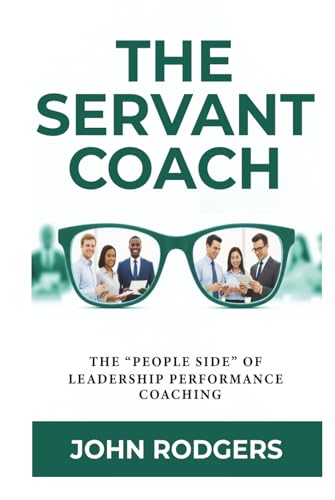
The Servant Coach
The “People Side” of Leadership Performance Coaching
The method behind the philosophy. The Servant Coach introduces the Five T’s of Coaching and a ten-step one-to-one coaching process that any leader can run with the people who report to them.
It is human-centered leadership development written for practitioners: how to open a coaching conversation, how to give feedback that is heard, how to set goals people own, and how to keep the momentum going between sessions.

Guidebook for Leadership Performance Coaches
From The Servant Coach: The “People Side” of Performance Coaching
The companion workbook to The Servant Coach, written for franchise and leadership performance coaches. It walks through John’s ten-step one-to-one coaching process step by step, from the first sponsor meeting to the final follow-up.
Use it alongside The Servant Coach to run the process with your own people: setting up the feedback team, debriefing the profiles, scheduling the sessions and writing the final report.
Buying for a leadership team? Ask John about bulk orders and using these books as the backbone of a team program.
Bringing the books to your team?
John regularly leads book-based leadership cohorts and retreats built on Becoming a Servant Leader, 2nd Edition, The Servant Coach and the Guidebook for Leadership Performance Coaches.